Easter is a celebration forever intertwined with Greek tradition: with deeply rooted rituals that emerged centuries ago, with solemn devotion, with family gatherings set against spring landscapes, with each region preserving its own Easter story, its own customs and habits that are faithfully observed to this day.
Translation | Amaryllis Tsegou
The customs and delicacies of the greatest celebration of Christianity
The Egg of Life, the rebirth of Nature, the hopeful message of the Resurrection and Eternity - Easter is, not by chance, the greatest celebration of Christianity. It’s the celebration that brings together all the themes of human existence: each person’s Golgotha, martyrdom, mourning and loss, but also the emergence - no matter what - into the final Holy Light.
These are truths that have endured since the dawn of humanity; rituals that traverse civilizations and eras, while remaining unchanged and ever relevant.
This celebration speaks to our hearts more than any other, because it is measured to the scale of human experience: it embraces our struggles and offers understanding, hope and consolation. And all this unfolds with the complicity of the most beautiful season of the year - the rebirth of nature, bursting with color, passion, and fragrance. Let us look back to our roots and remember what “Greek Easter” truly means.
Come, let us crack eggs!
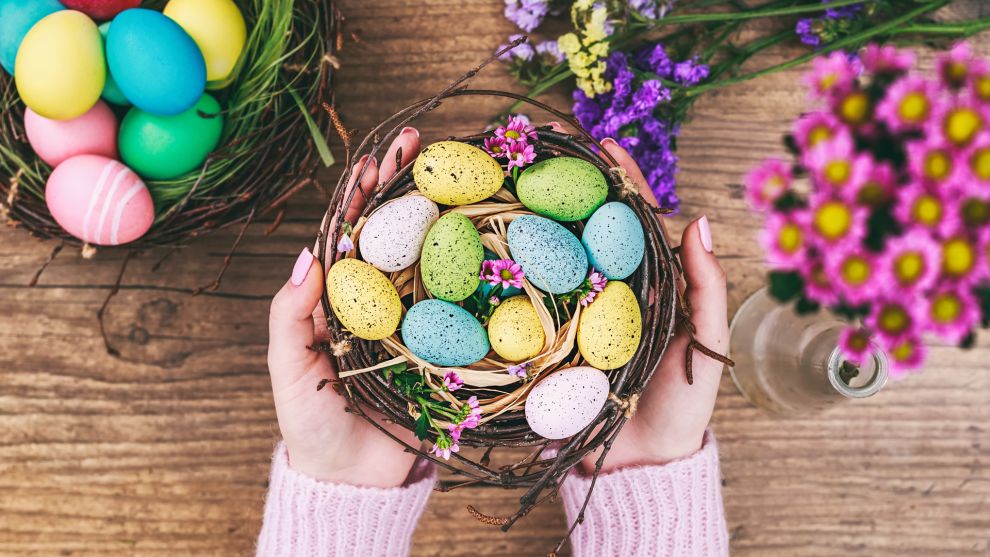
On Holy Thursday, the culmination of sorrow arrives with the Crucifixion of Christ and in every home the Passion is honored by dyeing eggs red, symbolizing the blood of Christ.
The custom of cracking eggs began and became established in the Byzantine court of Constantine the Great and Saint Helen, who celebrated every year on Easter Sunday morning with their people in a magnificent feast that began with the cracking of eggs between rulers and subjects.
Yet the symbolism of the egg is as ancient as the beginnings of the world itself: Egyptians, Indians and Persians, as well as countless myths from Polynesia to Finland, believed that the world was born from a great egg. The egg therefore emerges as a symbol of life and of rebirth.

Easter and the Resurrection, in different forms, have been celebrated since antiquity at this time of year. For spring itself is Resurrection: the end of winter, Life triumphing over Death, Persephone rising from Hades; it is the earth bearing fruit and turning green once more. In Christianity, the egg symbolizes the end of fasting, the beginning of new life and also the hermetically sealed tomb of Christ, which concealed eternal life within it.
According to tradition, after the Resurrection, Mary Magdalene went to Tiberius Caesar to announce, “Christ has Risen.” He replied ironically, “Yes - just as this egg here is red,” pointing to an egg beside him. At once, the egg turned red and Tiberius embraced the new faith. As many as the regions of this land, so too are the countless beliefs surrounding the red Easter egg.
The Easter egg in every corner of Greece
In earlier times, eggs were dyed late at night, and in many parts of Macedonia, red cloths were hung on windows the same day to ward off the evil eye. In Kastoria, women would hang red headscarves and blankets and in Corfu, twelve eggs are dyed - one for each Gospel - or one for every member of the family.
In the past, in village homes, the first red egg was placed in the icon stand, dedicated to the Virgin Mary and used to make the sign of the cross over children as protection against the evil eye. The following Easter, the old egg would be buried in the fields to ensure a good harvest. Elsewhere, housewives would cover the dyed eggs with a cloth, uncovering them only just before the Resurrection service, where each person would carry their egg, waiting for the first “Christ has Risen” chant.
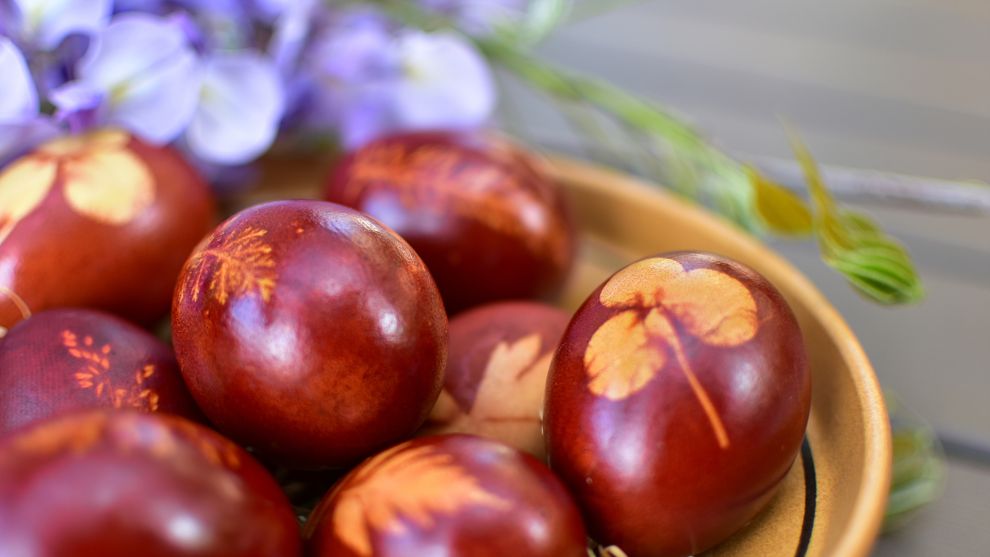
Before artificial dyes became readily available, eggs were colored using natural materials: onion skins, straw, almond leaves, poppies, parsley, saffron, violets, seaweed, or vartzi, a type of red wood.
The water used for dyeing the eggs was kept for forty days and even afterward it was forbidden to pour it outside the house.
Using old stockings, along with flowers and leaves, people decorated their Easter eggs. Unmarried girls adorned them with scenes from the Passion, with birds - especially proud partridges - and with patterns created from melted wax, like embroidery. These eggs were true miniature works of art, intended as gifts for future mothers-in-law, prospective grooms, godparents, godchildren and other loved ones. At times, the girls would even add wings and tails made of colored paper and hang them from the ceiling.
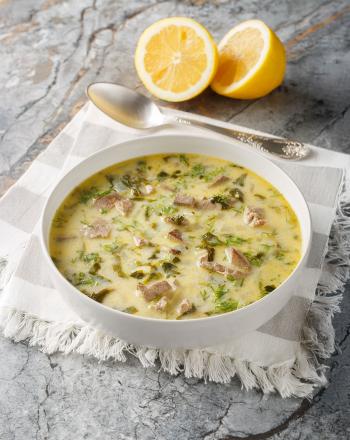
Magiritsa - the traditional Easter soup
After a strict and prolonged fast, the Resurrection table gently marks the transition back to a normal diet, which begins with a soup - or a dish - made from the lamb’s entrails, which are then fully enjoyed on Easter Sunday.
Magiritsa takes center stage on the night of the Resurrection. It prepares the body without weighing it down, while also carrying its own symbolism, as the fresh greens it contains recall the bitter herbs eaten by the Jews during their enslavement in Egypt.
Its name means “little cooking pot,” suggesting a simple, humble dish - exactly what the body craves - serving as a bridge from fasting to the following day’s rich and festive Easter table.
Magiritsa is not a single, fixed recipe, but many. Depending on the region, you may find it as a soup or as a thicker dish eaten with a fork; sometimes red and stewed, other times bright with lemon, with or without rice, made with intestines or only with liver, sometimes including the head or trotters, with lettuce or just spring onions and herbs - or even spinach. It may be egg-thickened (avgolemono) or served plain with a lemony broth. In Cyprus, it is prepared not with rice, but with wheat.
The first meal after the Resurrection, however, is not limited to magiritsa alone. Every region in Greece has its own customs and dozens of variations for welcoming the joyful message of the Resurrection.

In Crete, for example, magiritsa is traditionally found only in urban, affluent households - a practice that dates from the 19th century onward. The Cretan Resurrection table more commonly features chicken soup, gardoumia, kokoretsi and sometimes oven-roasted goat, while in the Asterousia region, it is celebrated with lamb’s head cooked with rice.
In Rhodes, the Easter soup is made with the lamb’s neck, legs, head and belly and is distinguished by a strong aroma of cinnamon.
On Therasia, near Santorini, preparations begin on the afternoon of Holy Saturday: small intestines are wrapped around sprigs of rosemary and cooked together with the lamb’s head and trotters.
In Corfu, after the Resurrection, people enjoy a thick soup prepared in many variations, typically with sow thistles, chervil, myronia, lettuce and offal - sometimes finished with egg and lemon, other times cooked in a rich tomato base.
In Mani, a hearty dish is made with offal, plenty of garlic and tomato, while another version of magiritsa is prepared egg-thickened, enriched with synglino and yogurt. On Holy Saturday night, many regions opt instead for a meat soup - made with lamb, beef, or chicken - while lamb fricassee is also a common alternative for those who prefer to avoid entrails.
The Easter lamb
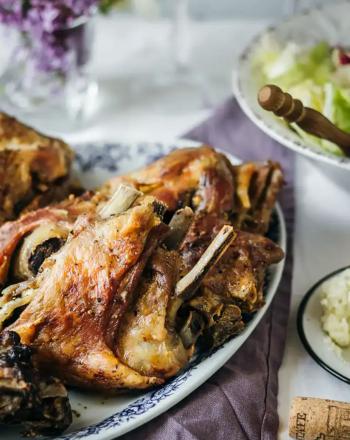
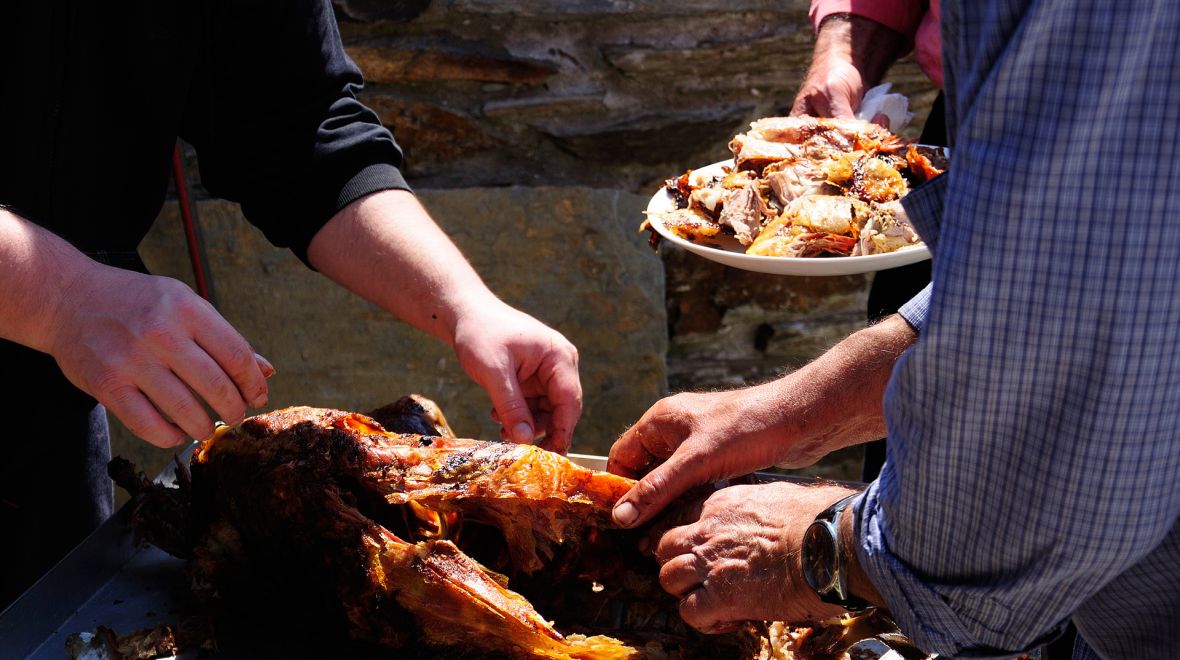
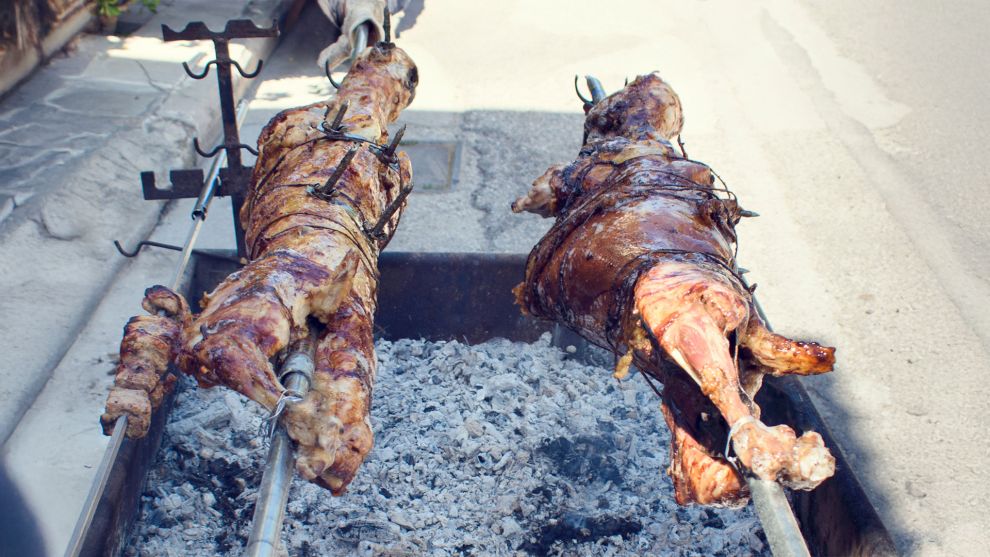
Easter may be most closely associated with lamb on the spit, but in reality, on the feast day itself Greece is divided between the oven and the spit.
The custom of spit-roasted lamb reaches back into the depths of time: it may be a remnant of an ancient pastoral feast that passed into Christianity - an offering to God, accompanied by prayers for the fertility of the flock.
In the Greek Orthodox tradition, the custom also has its roots in the Book of Exodus and the final plague visited upon the Egyptians. In order to compel Pharaoh to allow the Exodus of the Jews, God decreed the death of all the firstborn sons of the Egyptians, along with their firstborn animals, through the “Angel of the Lord.” To avoid this fate, each Jews household sacrificed a young one - whole, with no bone broken - and marked their doors with its blood, so that the Angel would recognize their homes and pass over them. In another interpretation, the Easter lamb symbolises Christ, the “Lamb of God,” as John the Baptist called him: “the lamb who takes away the sin of the world.”
In modern Greece, the custom seems to have begun with the shepherds of mainland regions, who celebrated Easter at their winter pastures. Lacking ovens, they improvised: two forked sticks fixed in the ground and a sharpened branch for a spit - simple tools that gave rise to a tradition later adopted across the country.
Behind this custom, however, lies a practical reality that may slightly dispel the magic of the celebration. Ewes and goats give birth around January and by Easter their young have grown enough to be slaughtered. The flocks have multiplied - but with summer approaching and the grass soon to dry up, the land cannot sustain so many animals. The herders must thus reduce their numbers and so this necessary act becomes a ritualised, almost sacred sacrifice.
Today, Roumeli and much of Central Greece remain firmly devoted to the spit, while elsewhere the lamb is roasted or cooked in a variety of ways - often with different names for similar dishes.
In Crete, Easter lamb is traditionally oven-roasted, often on vine branches, but also prepared antikristo - large pieces arranged on spits in a circle around the fire, facing outward, cooked slowly by radiant heat. Cretan tables however also feature lamb in avgolemono, boiled or stewed in tomato with homemade pasta and most commonly lamb with artichokes in an egg-lemon sauce.
In Epirus, lamb is cooked in a covered pan with wild greens. A beloved local specialty is lamb caul fat stuffed with entrails and herbs, baked in the oven or simmered in tomato sauce - a dish also found in many parts of Macedonia.
On Pelion, lamb is roasted on the spit on Easter Sunday, while on the second day of Easter, village homes bake lamb with potatoes in wood-fired ovens sealed with dough, giving the dish a distinctive smoky flavor.
In Chalkidiki, lamb is baked with an abundance of fresh and dried onions, dill, mint and rice.
Further south, in Patras, lamb is cooked in a pot together with its belly and trotters.
In Evros, one of the most unusual recipes appears: the lamb is first roasted with spring onions and mint, then combined with a porridge of stale bread and milk, and returned to the oven until it develops a golden crust.
Across Thrace, festive tables may feature lamb cooked with large quantities of parsley and finished with an egg-lemon sauce, while oven-baked lamb with rice is also common.
On Tinos, lamb with oregano is prepared with a rich, thickened sauce and served with fried potatoes.
On Andros, the lamb is stuffed with rice, herbs, entrails, cheeses, and thirty-three eggs - one for each year of Christ’s life - before being baked.
In Olympos on Karpathos, a Byzantine-era custom lives on in vyzanti: lamb or goat stuffed with rice and fresh herbs, sealed in a clay vessel, and slow-cooked overnight until meltingly tender.
In Sifnos, the young goat is placed in the oven from the previous day, resulting in exceptionally tender meat that melts in its own rich juices - an oven dish with the texture of a slow-cooked stew.
In Kalymnos, stuffed goat is coated with a mixture of tomato paste, butter, salt, and pepper, then baked in a wood-fired oven sealed with mud - a method also found on Naxos.
Stuffed goat with rice and herbs is also typical of Samothrace, while across the Dodecanese one finds goat filled with rice, entrails, spring onions, fennel and dill. On Astypalaia, the stuffed goat bakes slowly through the night.
On Lesbos, a female goat is roasted for hours wrapped in caul fat, often stuffed with chestnuts, pine nuts and raisins.
The Ionian Islands offer a different approach: in Corfu and Zakynthos, a rich avgolemono soup is prepared with beef, lamb, and rice.
Limnos offers one of the most elaborate recipes: the lamb is first roasted, then rice is cooked in its juices. The meat is returned to the pan with the rice, alongside slices of local kalathaki cheese and fennel and is baked again. A stuffed version is also made, enriched with raisins and an abundance of herbs.
In Samos, the stuffed goat is prepared with particular flair, as the dish also includes finely chopped lung, tart apple and a hint of cinnamon.
All the recipes echo one another yet vary from place to place: cumin here, tomato there; vine branches in one region, sealed ovens in another. However it is prepared, the result is always festive, distinctive and deeply satisfying. Because tradition - and perhaps instinct - recognises that lamb and goat at this time of year are at their most tender and flavorful, nourished by the fragrant vegetation of spring. From this sacred animal, nothing is wasted: even the bones were once buried in the fields - an offering back to the earth, providing nourishment for the harvests to come.
Kokoretsi, Gardoumakia, Gardoumbes
The lamb that is sacrificed must be fully honored - nothing from it should go to waste. Above all, its tender, flavorful entrails, which Greek tradition transforms in countless ways.
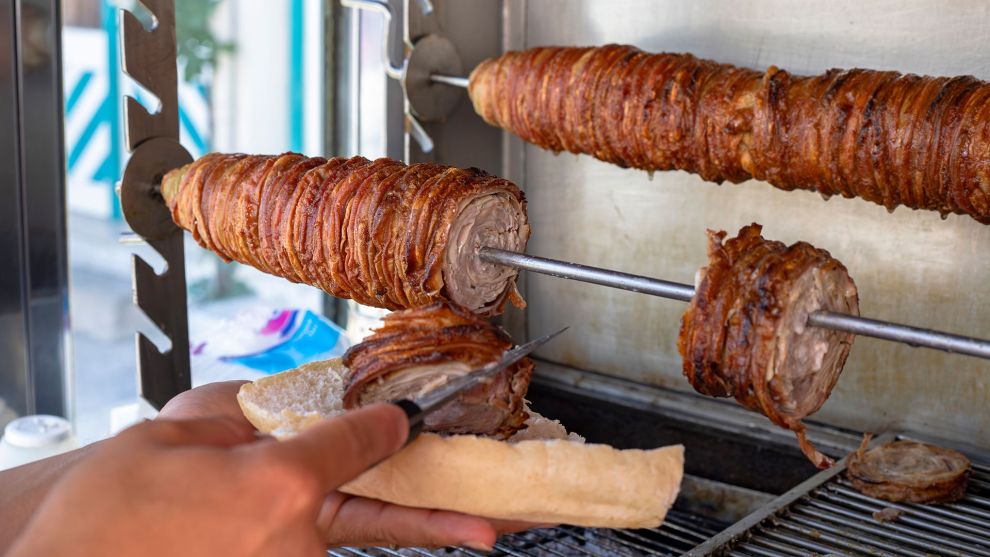
Kokoretsi, which comes off the spit even before the lamb is ready, is perhaps the most irresistible Easter bite: the prelude to the feast, a choice meze for the Easter table - rich, aromatic and perfectly suited to the tsipouro over which the first Resurrection wishes are exchanged.
Alongside the lamb or goat, offal takes center stage in delicacies especially prised by connoisseurs - those who gladly leave the simpler, plainer roast to others.
In Roumeli, kokoretsi is preferred large and thick, though smaller kokoretsakia are also made, as well as gardoumba: offal cooked whole in a pot, along with sweetbreads, spring onions, dill and parsley.
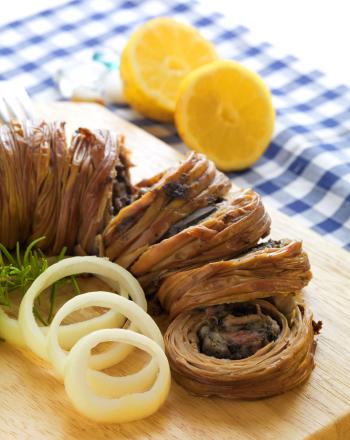
In Crete and in Naxos, one finds gardoumia - intestines braided into thin strands and wrapped around pieces of stomach. Gardoumakia or gardoumbakia are grilled over charcoal or cooked in various ways: in Chania they may be stewed in tomato or braised with zucchini and trotters, which enrich the sauce, though they are equally enjoyed in a lighter, lemony version.
In Thessaly and Aitoloakarnania, finely chopped intestines are baked in the oven with tomato, dill, parsley and spring onions.
Often, the lamb itself is cooked together with its entrails, as in Kozani.
Among the best-known offal delicacies are the tzigerosarmades of Thrace and Macedonia. Tzigerosarmas may be baked whole in a tray or rolled into small parcels, wrapped in caul fat and filled with finely chopped liver, rice, spring onions and herbs. Variations include papadies - small caul-fat rolls stuffed with liver, parsley and garlic, grilled over charcoal - as well as frygadelia and the sarma of Mykonos, where caul fat encloses liver along with fennel, dill, parsley and spring onions - the full freshness of spring herbs.
In its simplest form, offal is quickly sautéed in a pan and deglased with lemon and oregano - a cook’s meze, enjoyed by those tending the spit even before the table is set.
The Pies
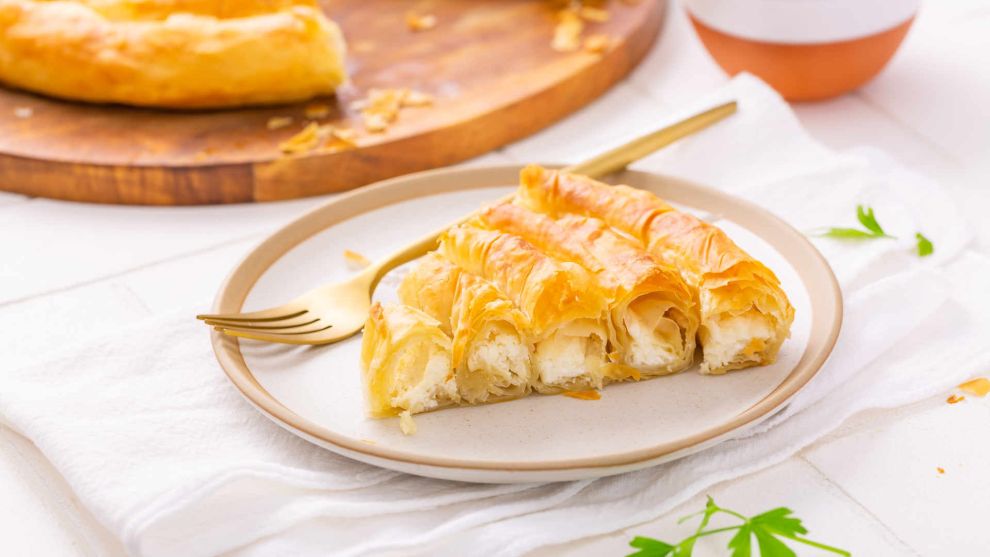
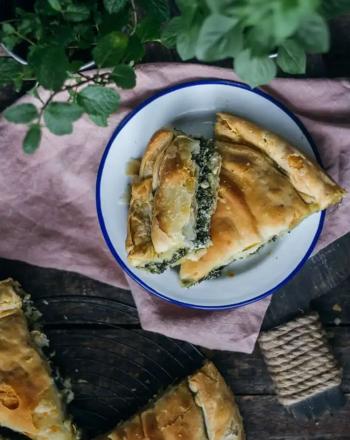
After the long fast of Lent, cellars are full of eggs, milk flows abundantly and richly flavored and the fields are brimming with fresh greens and herbs. Cheesemakers produce fresh, soft white cheeses and there is no better way to bring all these gifts together than in a pie. Alongside the lamb, sweet or savory pies are an inseparable part of the Easter table.
In Chania, a meat pie is essential, made with lamb, myzithra, staka, mint and pastry enriched with yogurt. On Astypalaia, Easter pies are flavored with local saffron and fresh myzithra, while in Kos they take the form of small tartlets with crisp yogurt dough and cheese filling.
Mykonos is known for its onion pie, made with tangy tyrovolia, spring onions and bread dough. In Epirus, cheese pies and wild greens pies dominate and more broadly, the Easter pie tradition ranges across countless variations of cheese-filled and herb-filled pies made with seasonal greens.
Celebrate Easter with these traditional Greek recipes