
Caught in the whirlwind of time, most of our traditions have faded into oblivion. And yet, our traditional recipes remain more relevant than ever. All of them economical, born out of the everyday life of a people who struggled to get by, they still speak to us today in the difficult times we are once again experiencing.
Translation | Amaryllis Tsegou
And it is not only about cost - it is primarily about memory: the taste we all love because it comes from the past, the embrace of safety offered by tradition. This year, then, let us celebrate traditionally, setting the table with nostalgic recipes that require neither special talent nor advanced techniques, drawn from our national cookbook of love.
Ragoutsaria of Macedonia
Macedonia’s Christmas customs seem endless. Christoxylo (Christ’s log) is the finest piece of wood each householder searches for in the mountains - a log that will burn continuously in the fireplace from Christmas to Epiphany, keeping the newborn Divine Infant warm. Before being placed in the hearth, it is thoroughly cleaned to drive away evil spirits, and its ashes are later scattered over the fields to ensure a fruitful new year.
Christopsomo also plays a central role in Macedonia, and in many areas it is known as “Christ’s honeyed bread.” Made with fine flour, rosewater, cinnamon, cloves, and sesame, it is placed at the center of the table to “feed” the infant Jesus.
In Halkidiki, a massive loaf is baked and shared with honey, walnuts, and wine among all the villagers, in the midst of exuberant feasting with song and dance.
On the festive table, one finds fried pork, cabbage rolls symbolizing Christ’s swaddling clothes, chicken soup, roasted suckling pig, and pickled vegetables. The table is left set overnight so that Christ may come and take His share of the joy. Another custom is “Kolinta Bambo,” meaning “They slaughter, grandmother”: bonfires are lit and people shout the phrase, a ritual reference to Herod’s massacre. Yet Macedonia’s most distinctive feature is the Ragoutsia and Ragoutsaria - Dionysian celebrations that survived within the Christian calendar, as if Carnival and Christmas were being celebrated at the same time.
In the same spirit are the Momoeroi, brought by Pontic refugees, as well as the custom of the Gamila in Giannitsa, which reenacts a love story from the years of Ottoman rule. The festivities are concluded triumphantly with kladaries - large bonfires lit to warm the newborn Christ. Among the festive dishes, standouts include m’soura (a trio of beef, pork, and chicken cooked with rice and vegetables), sarmades, isli, saragli, and sykotourta (liver pie).
Kolianta and Babo of Thrace
In Thrace, people say that the festive season begins forty days earlier, as this is when young men start rehearsing kolianta (carols). There are so many of them - just to give you an idea, a single village may have up to 45 different Christmas songs! And how could it be otherwise, since each group sang a different song for every member of the household who opened their door to them. On the morning of Christmas Eve, men would flood the streets carrying tzoumakes—wooden staffs symbolising Joseph’s rod—with which they knocked on people’s doors. Different songs were sung by children, young men, and the elders.
Christmas Eve honors the pig slaughter, for Christmas without pork is inconceivable. That evening, the fasting table must be set with nine foods, symbolizing the nine places visited by the Virgin Mary and Joseph after fleeing Herod: wine, pie, honey, saragli, melon, watermelon, garlic, and onion - each carrying its own symbolism. Alongside them were bougatsa and christopsomo, cut by the master of the house.
Babo, meaning “grandmother,” is the dish that breaks the forty-day fast on Christmas Day. It is pork intestine stuffed with liver, rice, onions, and pork belly. The table also included pousourti (pork preserved in its own fat) as well as pork chops.
Throughout the Twelve Days of Christmas, Thracians take every opportunity to dress in disguise. One such custom is Pourpouris, brought by refugees from Eastern Thrace. “Pourpouris” wears animal skins, a mask made from dried gourd, bells around the waist and goes from house to house with his group singing Christmas songs. Thracian housewives also prepare the festive sweets: saragli, sesame pies, karyokes, kataifi, isli, cookies, diples, and baklava.
Thessaly’s “Gournohara”
In Thessaly, gournohara—the pig-slaughter feast—is celebrated tirelessly for two or even three days. On Christmas Day, every household roasts its own gournada, while groups go door to door striking doors with sticks as they sing carols. The housewife leads them to the hearth, where, stirring the fire with a stick, they recite wishes for the household’s happiness.
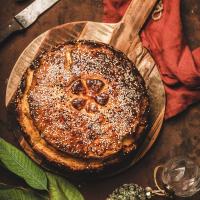
The New Year’s pie is filled with a coin, a straw, a blade of grass, a stone, and a kernel of corn. The head of the household turns the pan three times and distributes the pie to the family: whoever gets the stone will have health; straw and grass foretell land and livestock; the corn promises a good harvest; and the coin brings great wealth.
Karagouna housewives shape kloures and egg breads for the children who sing carols, while the festive table always includes soup and a hen stuffed generously with rice, figs, raisins, and liver. After the Christmas night service, women distribute bread and fried chicken to the faithful - some inside the church, others outside - so that the souls of the departed may be forgiven.
On New Year’s Eve, housewives would go late at night to the village spring, anoint it with fat, and scatter their fruits and coins. They would then rise at dawn to bake the lavishly decorated vasilokloura, hiding inside it a plum twig, a grain of wheat, cow hairs, and the coin - all symbols of abundance and prosperity. After the morning service, the pie was shared with parishioners along with cheese. A vasilokloura was also made specifically for the animals. At home, the head of the household cut the vasilokloura on a wooden board, placing a knife and fork beside it for anyone absent abroad or serving in the army. Whoever found the hair would gain livestock, the twig promised land, and the coin brought happiness for the entire year.
If you visit Livadi of Elassona, you can still witness the Babaliouria on New Year’s Eve, a custom surviving from antiquity. Men sing carols wearing baggy trousers, bells around their waists, and a mask made from animal hide called foulina. Along also comes adelfogyritis, who collects money. Using a sword, they block the path of worshippers leaving church, asking for offerings. Their bells drive away evil spirits and usher in the joy of the new year.
In Larissa, the New Year’s pie is a meat pie with a coin, while festive dishes include karvavitsa (pork intestine stuffed with liver), kavourmas (pork cooked in its own fat), and armia (cabbage preserved in brine and cooked with pork).
In Pelion, Christmas dishes included hen with chestnuts, pies, assorted meats sealed in a clay pot with pieces of graviera cheese, pork with quinces, and baklava made with olive oil.
On Christmas Eve night, housewives heat a large stone slab over the fire and bake lachanites on it, like crepes, symbolizing the swaddling clothes of Christ. They are then cut into pieces, placed in a pan, and drizzled with honey or sugar. These were eaten on Christmas Eve along with trahanas. Pig slaughtering is also central here: nothing from the animal is wasted, not even the skin, which is used to make the famous gournotsaroucha. From the slaughtered pig they prepare tsigarides, cured meat, and loukanitses—sausages with finely chopped meat, leeks, and onions.
Every New Year’s Eve, housewives shape round breads marked with dots on one side, known as gouziaries, which are placed on the animals’ horns. If they fall with the dotted side facing up, the year will go well. The sweet found everywhere is “Christ’s swaddling clothes”—pancakes baked on a scorching stone and soaked in sugar syrup, served with walnuts and cinnamon. The Christmas table also features giaprakia, cabbage rolls symbolizing the swaddling of Christ.
In the villages of Arta, on Christmas Day, visitors carry a lit branch of kermes oak into the house. The crackling sound symbolises the wish that everything—fields and harvests alike—will prosper. When emigrants return home for the holidays, the village square hosts the ziafeti, a two-day, exuberant feast. In Arta, the custom of “silent water” still survives: women go late at night on Christmas Eve to fetch water from the spring without speaking, whispering the wish, “As my spring flows, so may my harvest flow.” They would leave food behind, ostensibly to feed the spring, but in truth for the poor and the helpless. Here too, christopsomo is prepared with reverence and embroidered with intricate decorations of nuts and acorns symbolizing abundance.