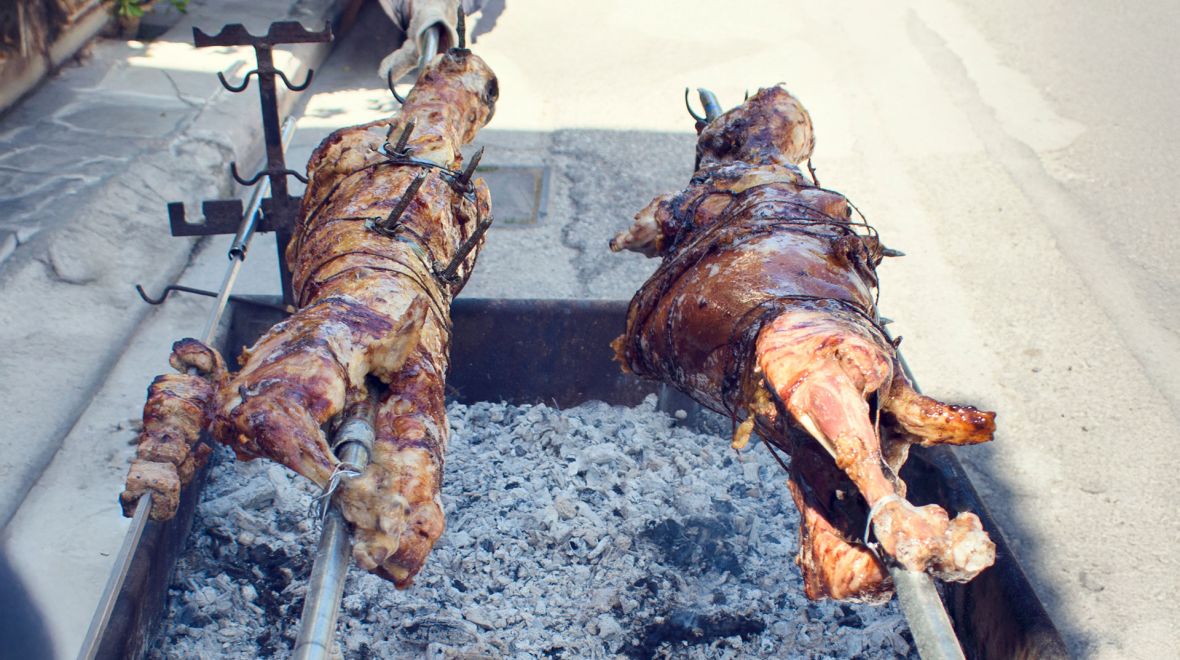


For many, Easter is unthinkable without an outdoor spit-roast: the traditional village celebration, the irresistible nibbling of crispy skin as the lamb - or goat, depending on preference - slowly turns, filling the air with its rich, smoky aroma. Alongside it come mezze, red eggs ready to be cracked, songs and dancing.
Translation | Amaryllis Tsegou
Others may not be as fond of the custom, yet almost everyone - through tradition and memory - associates Easter with this centuries-old practice. But where did it originate?
The answer is partly symbolic, partly religious - and, of course, deeply rooted in Greek tradition.
Jewish Roots
The custom of spit-roasting is closely connected to the Jewish Passover (Pesach), during which a lamb was sacrificed to commemorate the salvation from Egypt.
Jesus himself, as a Jew, also observed Passover, and the timing of His Resurrection coincided with it. In this way, the symbolism of the lamb passed into Christian tradition.
According to tradition, the lamb was slaughtered and roasted whole over the fire, without being cut or having its bones broken, as it represented the sacrificial lamb. Its blood was placed on doorposts so that the Angel of Death would “pass over,” sparing the firstborn.
The events described in the Old Testament deeply influenced later Orthodox tradition. At the same time, roasting meat over an open fire is a practice that stretches far beyond this context, reaching back into prehistory.
Indeed, even in ancient Greece, animals - including lambs and goats - were sacrificed to the gods, especially in spring, in honor of deities of fertility and nature such as Demeter and Artemis.
The symbolism
Within Orthodox Christianity, the lamb came to symbolize Jesus Christ himself - the one sacrificed for the salvation of humanity and people’s redemption from sin. As it is written in the Bible, through the words of John the Baptist: “Behold the Lamb of God, who takes away the sin of the world.”
The Greek tradition of the spit
In Greece, roasting on the spit is not only a cooking method but a vital part of tradition, folklore, even hospitality. It is inseparably linked to family gatherings in the countryside, to the Easter journey from city to village, and to outdoor celebrations filled with song, dancing, mezze and nibbling the crispy skin from the animal on the spit.
Those who observe the custom begin preparations early - often at dawn - as the slow roasting takes many hours. Family members gather around the spit, sampling pieces of crispy skin as they cook. The person in charge of the spit - usually the most experienced - is treated almost as a “sacred” figure for the day, entrusted with ensuring everything turns out just right.
While the custom is similar across Greece, small regional variations exist. In Crete, for example, lamb is often prepared antikristo: large pieces arranged around the fire and cooked slowly by radiant heat, without the use of a spit.