
Before moving on to cooking, it’s important to focus on the preparation. First, wash the offal thoroughly and place it in a colander. Using a sharp knife and a cutting board, cut it into evenly sized pieces - ideally fairly large, roughly square or triangular chunks. This is a key step for a successful kokoretsi. Place the pieces in a bowl, season generously with salt, pepper and oregano and refrigerate until ready to assemble.
Translation | Amaryllis Tsegou
Next, prepare the intestines. Nowadays, you can often find them cleaned and redyat the butcher’s. If not, they must be cleaned very thoroughly under running water until they turn a pale, whitish colour. There are two main methods for cleaning them inside and out:
- Method 1: Use a wooden skewer to carefully thread through the intestine and turn it inside out. Do this under running water, continuously rinsing as you push and invert the intestine until you reach the end. Then repeat the process to turn it back again.
- Method 2: Run water through the intestine from the tap, gently pushing it along so the water flows through and exits clean from the other end. Rinse thoroughly.
Always keep the intestines loosely coiled to prevent tangling, and handle them gently to avoid tearing. Finally, place the cleaned intestines (coiled) in a bowl with plenty of clean water and a splash of vinegar.
Cooking tip
If you don’t have a charcoal grill or BBQ, you can cook Kokoretsi in a home oven. Adjust the quantity to fit an oven spit, wrap it in parchment paper, and roast at 180°C for about 1 hour. Then slit open the paper and continue roasting for another 15 minutes at 220°C.
Kokoretsi
Prep time: 20 mins | Cooking time: 50 mins | Total time: 1 hour 10 mins | Serves: 6-8
Ingredients
- 3-4 lamb intestines (about 2 kg)
- 2 large lamb offal sets, including sweetbreads
- 2 caul fats (lamb caul fat)
- 1 tbsp oregano
- salt and freshly ground black pepper
Method
- For Kokoretsi, first prepare the charcoal embers and have suitable spits at the ready.
- Thread the offal tightly onto the spit, alternating pieces of lung, liver and sweetbread until all the ingredients are used. Press them together firmly to avoid gaps.
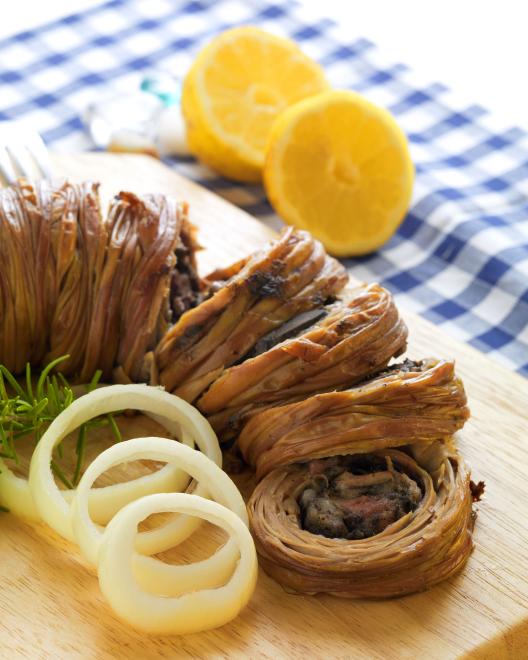
- Wrap the assembled skewer tightly with the caul fat, then begin wrapping with the intestines. Tie the end of the intestine securely to the spit and wrap lengthwise in a crisscross pattern, working your way down. When one intestine ends, tie it off and continue with the next.
- To finish, wrap the kokoretsi in tight circular movements, creating an even spiral that fully covers the surface. Secure the end well.
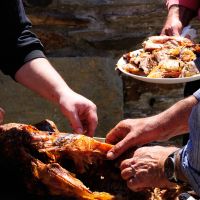
Place the kokoretsi high above the heat on the grill. As it cooks, gradually lower it closer to the embers. It is ready when the outside is well browned, slightly crisp and caramelised—this usually takes about 2-3 hours, depending on the thickness. - Once cooked, cut it into 2-3 large sections to remove it from the spit, then slice into even portions.