Extra virgin olive oil is one of the most iconic ingredients of the Greek diet. Although it has been used for centuries in all kinds of cooking - from stews to frying - there is still a widespread belief, both among consumers and professionals, that it “burns easily,” “can’t handle high temperatures,” “isn’t suitable for frying,” or “makes food heavy.”
Translation | Amaryllis Tsegou
Frying is one of the most popular cooking methods. From golden crunchy potatoes to crispy zucchini, fried food always has a place on the Greek table. But the question remains: which oil is actually best for frying?
For years, many believed that extra virgin olive oil was too delicate for high heat. Modern science, however, backed by numerous studies, now tells a different story: olive oil is not only safe for frying, it is also one of the healthiest and most flavorful options.
Does olive oil really burn easily?
The concern usually centers around the smoke point - the temperature at which oil begins to produce continuous smoke. For extra virgin olive oil, this typically ranges between 190-210°C. Since ideal frying temperatures are around 170–180°C, olive oil is well within a safe range for cooking and frying.
A standard extra virgin olive oil can reach a smoke point of around 190°C, while very high-quality oils with acidity below 0.2% can go up to about 215°C. Acidity here refers to the level of free fatty acids, which is both a quality indicator and a factor in heat stability.
Still, the smoke point alone doesn’t tell the full story. What matters more is how quickly harmful compounds form during heating. In this respect, extra virgin olive oil performs exceptionally well thanks to its natural antioxidants, especially phenolic compounds, which help protect it from oxidation.
What happens during frying?
When oils are heated, oxidation and breakdown reactions occur, producing potentially harmful compounds such as aldehydes and polymers.
Seed oils like sunflower, corn and soybean oil contain high levels of polyunsaturated fats, which are more chemically unstable and oxidise quickly at high temperatures.
Extra virgin olive oil, on the other hand, is mostly made up of monounsaturated fats (mainly oleic acid ~70-75%), which are far more heat-resistant. It also contains vitamin E, phytosterols, squalene and phenols, all of which act as natural antioxidants.
As a result, olive oil produces fewer harmful compounds and is generally safer for frying than most seed oils. Studies also show that extra virgin olive oil can be reused for 3-4 frying cycles without significant degradation (provided it is filtered and stored properly in a cool, dark place in a sealed container), while seed oils degrade much faster and are unsuitable for reuse even after their first use.
Research from the IRTA center in Catalonia even showed that olive oil could withstand 21 repeated frying cycles without becoming toxic, though this is not intended as a recommendation for home use - it simply highlights its stability.
Unlike seed oils, which lose their already limited antioxidants quickly, extra virgin olive oil retains many of its protective compounds even after heating. At typical cooking temperatures, it also produces fewer aldehydes compared to sunflower or corn oil.
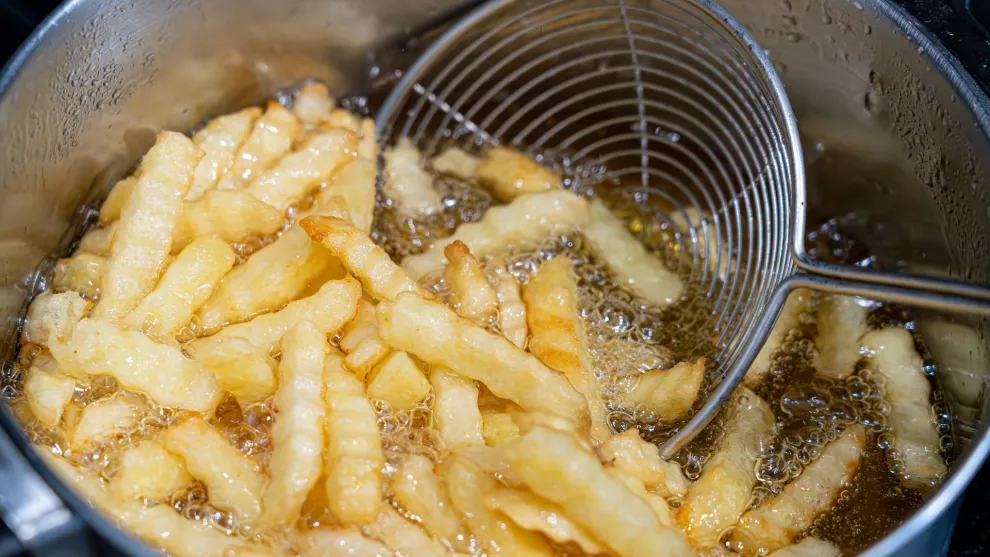
Acrylamide and olive oil
Acrylamide is a toxic and potentially carcinogenic compound that can form when starchy foods such as potatoes, bread, or cereals are cooked at high temperatures. Its formation is linked to the Maillard reaction, which is responsible for browning and flavor development in food.
Oil plays an important role here. Because seed oils oxidize more easily and lack strong antioxidants, they can contribute to higher levels of unwanted by-products that encourage acrylamide formation.
Extra virgin olive oil, by contrast, contains antioxidants such as phenols and vitamin E that help limit oxidation.
Research has shown that potatoes fried in olive oil tend to contain lower levels of acrylamide compared to those fried in sunflower or corn oil.
In simple terms, acrylamide cannot be completely avoided when frying, but choosing extra virgin olive oil can help reduce its formation.
Does olive oil lose its nutritional value when heated?
In short: no. In fact, studies show that cooking vegetables with extra virgin olive oil can even increase the total antioxidant content, particularly phenolic compounds. Boiling in water, by comparison, reduces them.
Olive oil also improves the absorption of fat-soluble nutrients. Compounds like beta-carotene in carrots or glucosinolates in broccoli are absorbed more efficiently when cooked with olive oil. So rather than losing value, olive oil can actually enhance the nutritional quality of food.
Does it improve flavour?
Yes - and noticeably so. During frying, extra virgin olive oil forms a light protective layer on the surface of food, helping seal in moisture and aromas.
The result is food that is crisp on the outside, juicy on the inside, and less greasy overall. Its flavor advantage over seed oils is clear.
Olive oil versus seed oils
Across every category - health, stability, and taste - olive oil stands out. It is rich in monounsaturated fats and antioxidants, requires no industrial processing, and is more resistant to heat breakdown. It also enhances flavour rather than masking it.
Furthermore, it is worth remembering that olive oil is a local product, while most seed oils are imported.
Cost and types
Extra virgin olive oil is the highest quality and the most expensive, but it can often be reused, making it more economical over time - and when health is taken into account, the value is even clearer.
Other options include virgin olive oil, which is slightly lower in quality but still natural and standard olive oil (a blend of refined and virgin oils), which is processed but still preferable to seed oils.
All categories of olive oil, including pomace oil used in large-scale catering, are considered better choices than seed oils in terms of both stability and health.
What science says
The PREDIMED study in Spain found that a diet rich in olive oil reduced cardiovascular events by about 30% compared to a low-fat diet.
EU Regulation 432/2012 also recognizes high-phenolic olive oils (with 250 mg/l or more of polyphenols) for their health benefits, particularly their ability to protect blood lipids from oxidative stress. Around 20 grams of such olive oil daily contributes to these protective effects.
Beyond the science, there is also taste. Extra virgin olive oil is not just a cooking fat—it is a flavor enhancer that elevates even the simplest dish, from a fried potato to a piece of fish, everything is elevated simply by the addition of olive oil.
Practical advice
Extra virgin olive oil can be used for almost all types of cooking, such as sautéing, baking or frying. And fear not- it is more stable than most vegetable oils and while it’s useful to avoid letting it smoke, it performs very well at normal frying temperatures.
For best results, use high-quality Greek extra virgin olive oil. And for extra aroma, a small drizzle of raw oil at the end of cooking makes a noticeable difference.
Oil recycling
Proper disposal of used frying oil is essential, both for environmental and health reasons. Pouring it down the sink can clog pipes and pollute soil and groundwater. Instead, used oil should be collected in sealed containers and taken to recycling points, where it can be turned into biodiesel and other useful materials.
In this way, we help protect the environment, put a waste product to good use instead of letting it end up in nature and actively support the circular economy. If it’s not possible to take the used oil to a recycling point, the next best option is to store it in a tightly sealed plastic bottle and dispose of it in the bin to avoid environmental pollution and plumbing issues.
Conclusion
Extra virgin olive oil is not just another food ingredient - it brings together culture, science and health in a single bottle. It withstands heat better than most other oils, retains its antioxidant properties and delivers exceptional flavor (in fact, it is considered the tastiest of all oils).
In Greece, olive oil is far more than a source of fat. It is at the heart of our national diet and a defining element of its cuisine. From everyday family meals to fine dining, it acts as a common thread that shapes flavor, health and tradition. It is living proof that just a single drop can carry the history of an entire place.