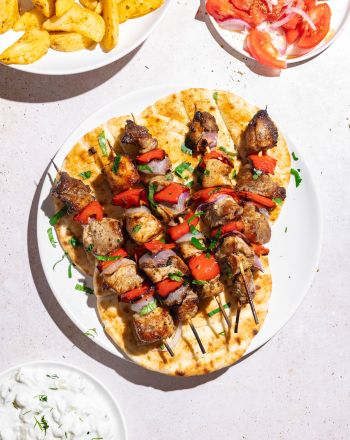
A little before the holiday feast, chef, butcher, and TikToker Nikos Marolis shares with us his secrets for cooking pork - depending on how we want to prepare it - as well as the ingredients that best complement it.
Translation | Amaryllis Tsegou
Stuffed turkey need not be the only option for Christmas and New Year’s. After all, it is a - albeit delicious - foreign custom we’ve adopted. Traditionally, pork is the classic choice for the holiday table. The custom of the choirosfagia, whose history is lost in the depths of centuries, is still honored throughout Greece during this season. The tradition takes place in various regions and spans a long period, from autumn through spring, depending on the area.
So if you want to go the traditional route this year and choose pork, here you will find the ways you can prepare it for the holiday table, which cut is most suitable for your chosen method, as well as suggestions for ideal ingredient combinations - as shared with us by chef and butcher at the family business “Kreopoleio Giannis” in Exarchia and TikToker Nikos Marolis.
In the pot, cut into pieces
Pork cooked in a pot - especially when prepared with leeks and celery - is perhaps the most common holiday choice when we don’t want to cook turkey. For this method, we typically choose shoulder (spala) or leg (boutí), requesting that the butcher cuts it into pieces or bite-sized chunks suitable for stewing. It needs to cook for at least 2 to 2.5 hours over low heat. You can prepare it in various recipes: the traditional leek-and-celery stew with avgolemono, lemon pork with artichokes, sautéed greens, or even tomato-stewed stifado, or paired with dried fruits.

In a roaster, whole or in cut
If we want to roast the pork in the oven, we will again choose shoulder or leg when roasting a whole cut. The best cooking vessel for this is a roasting pan with a lid. “If we don’t have a roaster, we can use a deep baking tray, covering the food with parchment paper and aluminum foil so it functions like a roaster,” explains Nikos Marolis.
A whole piece requires several hours of cooking - about 4 hours at 180°C with the fan on. But we need to be mindful: if the meat weighs more than 2 kg, calculate an extra 40 minutes of cooking per additional kilo. Half an hour before it’s ready, uncover the meat so it can brown.
If we choose pork cut in individual portions, then our best option is neck (laimós), which needs about 2 hours of roasting at 180°C in a roaster or deep tray as described above. Again, uncover it half an hour before removing it from the oven to give it color.
Whatever ingredients we use, the essential rule is that the cooking vessel must contain plenty of liquid so the pork can cook properly and become tender and glossy without drying out.
Rolled pork roast
If we want something more special, we can choose a pork roll; neck is the lighter option, and we’ll ask that the butcher cuts it specifically for rolling. Alternatively, we can request a whole pancetta, which is more fatty than neck.
In any case, we fill it with ingredients of our choice. A hard cheese - such as graviera - is essential and we can add cured meats like prosciutto or bacon and vegetables like bell pepper, leek, or onion.
“For something more impressive, a great idea would be to fill it with nuts like pistachios or pine nuts, dried fruits, corn, and herbs,” suggests Nikos.
We simply place the filling on the meat, roll it up and tie it with butcher’s twine. It will need about 2 hours and 30 minutes at 180°C with the fan and if we want it to stay juicy inside, we can wrap it in parchment paper and aluminum foil, uncovering it half an hour before taking it out of the oven.


Pork Tenderloin
“Pork tenderloin is always a good and easier option for the holiday table.” Start by searing the whole tenderloin in a pan to brown and seal it, then roast it in the oven at 180°C for about 20-25 minutes.
We can serve the tenderloin with a sauce made from cream, blue cheese, and Aegina pistachios, drizzling it over after slicing the meat into medallions on the serving dish.
Pork Shank
Pork shank is also an original choice that will certainly draw attention to the table. In this case, we must know that we need 4–5 hours of slow roasting at a lower temperature (150-160°C) in a roaster with plenty of liquid so that the meat is fully submerged.
The goal is for the meat to become so tender that it “melts,” so we can cut it with a fork when the whole shank is served on the table - just like pulled pork.
We can play around with cooking liquids- beer, orange or blood orange juice, or dry white wine, along with a sweetener such as honey or maple syrup, and we can also add chunks of tart apples.
As for serving the shank on guests’ plates, Nikos suggests, “As soon as we remove the shank from the oven and place it on a platter, we pull out the bone, and the meat essentially cuts itself - it should be extremely soft, so that once the bone is removed, the fibers release easily from the structure.”